






 Source: The White House, Wikimedia Commons |
Thailand has formally suspended its ceasefire agreement with Cambodia after a mine blast along the border resulted in “severe leg injuries” and chest pains in two Thai soldiers. The Thai government alleges that the mines were placed by Cambodia after the ceasefire had been reached.
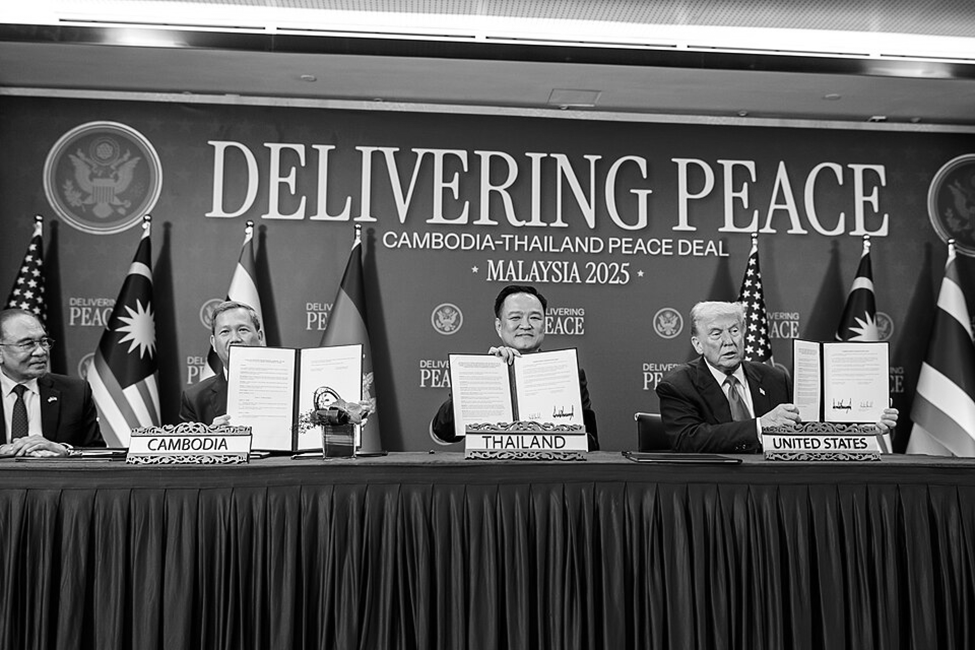
The Thai Ministry of Foreign Affairs (MFA) announced that the Kingdom will no longer participate in joint disarmament efforts or release the 18 Cambodian prisoners of war in their captivity as per the terms of the Kuala Lumpur Peace Accords signed at the 47th ASEAN Summit just two weeks prior.
The Thai military later launched a skirmish on a Cambodian border village, injuring two civilians and killing another, which Cambodia has condemned as a war crime.
Commenting on the potential consequences suspending the ceasefire will have on trade negotiations with the U.S., Prime Minister Anutin Charnvirakul told reporters that he “no longer cares” about the threat of U.S. tariffs.
The following day, the MFA confirmed receiving a notice from the U.S. Trade Envoy that negotiations will cease until Thailand commits to rejoining the Kuala Lumpur Peace Accords.
After private phone conversations with U.S. President Donald Trump, Prime Minister Anutin informed the public via Facebook that the U.S. did not condemn his decision and will not interfere with Thailand using “existing bilateral mechanisms” to resolve the dispute with Cambodia.
He also urged President Trump to separate the border conflict from trade negotiations, in line with the Thai government’s stance that they are two separate issues.
The White House and Office of the U.S. Trade Representative have yet to release a statement regarding negotiations with Thailand or the conflict with Cambodia, though Prime Minister Anutin claims that President Trump may be amenable to lowering tariffs if Thailand committed more efforts in mine clearance along the Cambodian border.